
Residential Services
Surveillance and Cameras
Our experts can help determine the proper system for you and your budget.

Home Surveillance and Monitoring

Empower your home's security with our state-of-the-art surveillance and camera systems, offering you peace of mind with crystal clear monitoring and real-time alerts.
Choose the view you need before choosing the camera
Start with the question each camera needs to answer. Do you want to see activity across the yard, recognize someone approaching the door, or review a delivery near the garage? A broad overview and a detailed identification view require different placement and framing. One wide image may show plenty of the property while leaving a person too small to identify.
Lens choice, mounting height, distance and lighting all affect useful detail. A higher megapixel count does not compensate for a poorly framed scene or a face hidden by backlighting. Review where people and vehicles will pass, rather than choosing locations only because a corner provides an easy mounting surface.
Phoenix conditions also make exposure worth discussing. Direct sunlight, bright backgrounds, heat and dust can influence equipment choice and maintenance. Weather ratings and operating temperature limits are model-specific. A thoughtful layout addresses priority views while acknowledging blind spots and the conditions under which an image may be less useful. Cameras can support awareness and review; they cannot guarantee that an incident will be prevented or captured clearly.
Automate Your Home Today!
Transform your living space into a smart home, where convenience and efficiency are just a touch away.
What We Do
Surveillance and Cameras
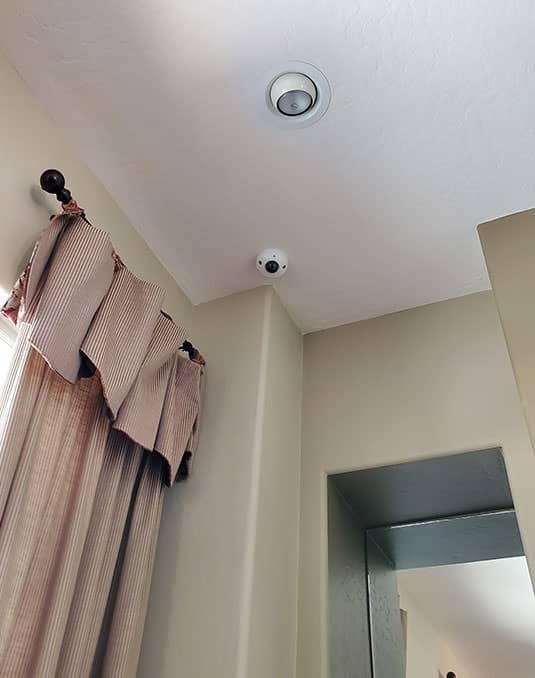
We all hope we never need a camera to record an event around our home. However, far too often, we do. Let us show you how affordable a camera system can be. We sell and install everything from a basic 4 camera system to elaborate systems that span 12 buildings in 3 states. Our experts can help determine the proper system for you and your budget.
Make night views and recordings part of the design
Evaluate the scene after dark as well as in daylight. Built-in infrared illumination can reflect from a nearby wall, eave, window or dirty camera cover, reducing image quality. Motion and uneven lighting introduce other challenges. Camera location and the surrounding surfaces matter as much as the advertised night-view range.
Recording needs deserve their own plan. Decide whether you need continuous recording, event-based clips or a combination, and how far back you expect to review. Storage depends on camera count, resolution, frame rate, compression and scene activity. A storage size alone does not promise a particular number of retained days.
Discuss local and cloud storage, subscription requirements, account permissions and how you will retrieve a clip. Remote viewing depends on the selected platform and an available connection; recording during an Internet interruption depends on the equipment’s local capabilities. Confirm those differences before choosing a system. Reviewing footage should be understandable to the people who will actually use it, including finding the right time and exporting a useful recording.
Prepare a camera plan that fits your property
Audio Video by Design brings more than 20 years of audio video experience to its work. A clear description of your property and recording priorities helps shape an appropriate camera consultation.
Prioritize entrances and useful detail
List the doors, gates, driveways and other areas you want to observe. Explain the purpose of each view and any particular distance or detail that matters. Photos at daytime and night can help the conversation. Consider property boundaries and neighboring spaces when choosing views, and seek appropriate advice if your plans raise questions about recording permissions.
Review power, cabling and equipment access
Share existing camera models, cable routes and the intended recorder location. Wired cameras need suitable pathways and power arrangements; wireless models still need an appropriate power source and reliable connection. Equipment placed in a hot, crowded cabinet may have different requirements from equipment in a ventilated interior location. Access for cleaning and future service should be part of the placement decision.
Decide who can view and manage recordings
Identify the household members who need access, how accounts will be secured and who owns recovery information. Review notification preferences so alerts remain useful. Discuss retention, export and any recurring service costs in the same conversation as camera selection. Different platforms offer different permissions and recording features; confirm what is included in the proposed configuration.
What We Do
Our Audio Video Services
A fully integrated AV system requires an in-depth design procedure to assure that all of the components
and sub-systems work together properly. Without a proper design, you may be subject to hidden charges later.


AV Design and Installation
A fully integrated AV system requires an in-depth design procedure to assure that all of the components and sub-systems work together properly.
View Service


Home Theater
Love watching movies? Hate going to the theater? Let us show you how we can design and install a state of the art theater in your home.
View Service


Home Automation
“Everybody does Home Automation now. I can even get it through my alarm.” Sound familiar? Can you get Home Automation through your alarm?
View Service


Whole House Audio
Music throughout is an awesome addition to any home. Play your favorite playlist throughout your home while you clean.
View Service


Distributed Video
Every start watching a movie in the family room, then decide to finish it in the master bedroom? Video Distribution fixes this issue.
View Service


Surround Sound
Do you ever think that surround sound is “too loud”? We hear this a lot. However, surround sound is no “louder” than TV sound.
View Service


Surveillance and Cameras
We all hope we never need a camera to record an event around our home. However, far too often, we do.
View Service


Computer Network and Wifi
Whether you have a full home automation system or just kids with electronic devices, the network keeps everything humming.
View Service


Audio Video Service and Repair
Don’t leave your entertainment system to just anyone. Hire the experts to make it right.
View Service


High End Audio
We can design a system that will tickle your ear while stroking your budget.
View Service


Lighting Control
Let your imagination (and a little direction from us) lead you to lighting ecstasy.
View Service


HVAC Control
HVAC control can save you enough money every year to pay for its self, four times over.
View Service


Window Coverings and Motorized Shades
You can open one or all your shades, with just a simple button press.
View Service








Testimonials
What Our Customers
Say About Us
Home surveillance camera questions
How many cameras will my home need?
Begin with priority areas and what you need to see in each one. Property layout, distances, obstructions and required detail determine whether one camera can cover an area usefully or separate views are needed. Camera count alone does not measure coverage quality. A site review helps identify the most useful positions and the limitations of each proposed view.
Will a higher-resolution camera identify every face or plate?
No camera can promise that in every condition. Identification depends on subject size in the image, angle, distance, lighting, exposure and motion as well as resolution. License-plate capture is a particular task that may need a specialized setup. Tell us the detail you want to review so the camera and view can be considered for that purpose.
How long can recordings be kept?
Retention depends on storage capacity and the selected recording settings, including the number of cameras and how much activity they record. Cloud plans may have their own limits. State your desired review period during planning, then ask how it will be estimated and confirmed. Adding cameras or changing video quality can change the actual retention period.
Can I see the cameras when I am away?
Remote viewing is available with many systems, subject to the selected equipment, account setup, service requirements and Internet connection. It is separate from the question of where video is recorded. Discuss who needs access, which devices they use, whether subscriptions apply and what remains available if the home's Internet service is interrupted.
What affects the cost of a camera installation?
Coverage areas, camera capabilities, cable access, mounting conditions, storage requirements and network or power upgrades all contribute. Recording plans may also add recurring costs. A smaller system aimed carefully at priority views can be more useful than more cameras placed casually. Compare proposals by the views, recording features and infrastructure they include.
Start with the areas you need to see and the details you need a recording to show. Bring a property sketch and any existing camera information to discuss a practical plan.
Phone Number
(480) 242-6459Office Address
30249 N. 124th Lane,
Peoria, AZ 85383
SEND US A MESSAGE


